Texts
The Temperature of the Senses
2018
Lim Eunsin
Artists create for many different reasons. Some work in order to convey a clearly defined message; others simply because they have something they want to say. Still others create because they feel a more ambiguous but equally compelling need—to draw, to make, to release something that must be let out. In any case, an artist is someone who expresses something, in one form or another. Whether through visual images, language, sound, or any other medium, they make something that can be sensed and place it before us.
In the past, the word “author” or “writer” typically referred to someone who wrote with words. Today, however, the term “artist” is more commonly used to describe those who work in the visual arts—those who make art to be seen. In this sense, “artist” becomes a conceptual translation of the broader idea of authorship. Previously, visual artists were identified primarily by their medium—painter, sculptor, printmaker, photographer, and so on.
Even painters were further divided into categories such as ink painting, oil painting, watercolor, illustration. But such genre-based distinctions no longer hold much meaning. Contemporary artists move freely across media, choosing whatever form best serves what they want to express. Painting, sculpture, installation, video—whatever communicates their intentions most effectively becomes their tool.
Park Jung Hyuk is one of the most representative artists of this condition.
Having followed what is considered the elite path for a painter in Korea—Sunhwa Arts High School and Hongik University’s Department of Painting—Park Jung Hyuk unexpectedly turned away from painting and instead focused on video and media-based work, through which he first gained attention. In retrospect, this seems almost inevitable. The critical consciousness underlying his practice is already evident in Training, the video work presented in his first solo exhibition《Malocclusion》.
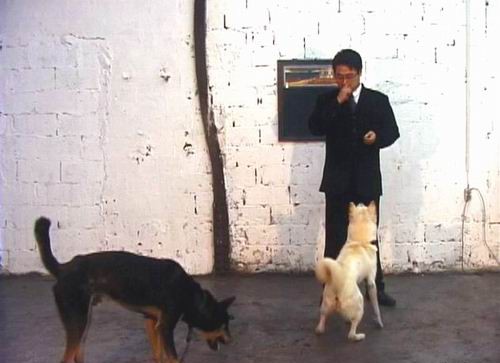
training, 2003, Single-channel video, 6min 13sec ©Artist
His central concern was the problem of structural power in society and the notion of discipline—not education, but discipline in its Foucauldian sense. Through a short video documenting his training of two dogs with treats over about a month, he reveals how power is produced and consumed, and how surprisingly fragile such constructed power structures can be. Discipline may be effective, but it can always be resisted and transformed.
Over the years, Park expanded this inquiry through various video and installation works, tracing how systems of discipline and education generate power relations that extend from the family to society at large. He never concealed his belief that the artist’s role is to expose social contradictions and contribute, however modestly, to their transformation.
“The message that runs through my entire body of work is that speaking through art about the contradictions generated by social systems is the role of the artist as a member of society. I believe that the accumulation of such individual acts can make us aware of the structurally internalized flow of social contradictions, and that serving as the vanguard of this awareness is the artist’s mission.” — Park Jung Hyuk, A Study on the Artistic Expression of Social Contradictions, MFA Thesis, Hongik University, 2012, p.42
In 2007, however, Park abruptly returned to painting with the ‘Park’s Park’ series—a move that was anything but conventional. Having previously approached social issues through the microcosm of personal and family narratives, he now adopted the most classical of media, painting, to speak about the contemporary era from a more expanded, macroscopic perspective.
Shifting from the viewpoint of “me” within society to that of “us,” he turned his gaze toward the overwhelming flood of images that surround us in everyday life—cinema, television, magazines, advertising.
These images, so characteristic of twenty-first-century visual culture, are seductive, glamorous, provocative, and often violent, whether directly or indirectly. Above all, they are commercial and therefore saturated with desire.
“The overflowing waves of media pour out countless images. These images are nothing more and nothing less than substitutes for desire. Produced for different purposes, they are in fact instruments of domination that conveniently control the desires of their producers. By recombining these images, I construct new narratives and prepare a modest rebellion.”— Artist’s Note, July 2009
The artist appropriates these images, recombines them, and constructs his own new narratives. What he seeks, however, is not for viewers to read those narratives correctly. On the contrary, he wants them to become aware of how many accumulated experiences and culturally learned symbols they must summon in order to interpret any given image.
‘Park’s Park’ is not an image that conceals a specific subject behind it; rather, it is a body of work that places its significance on the very construction of the pictorial field itself. For viewers accustomed to “correctly interpreting” images and searching for definitive answers, these works may appear difficult or even empty. The artist describes this painterly strategy as “an attempt to disrupt viewers’ trained iconographic readings by separating the signifier from the signified.”
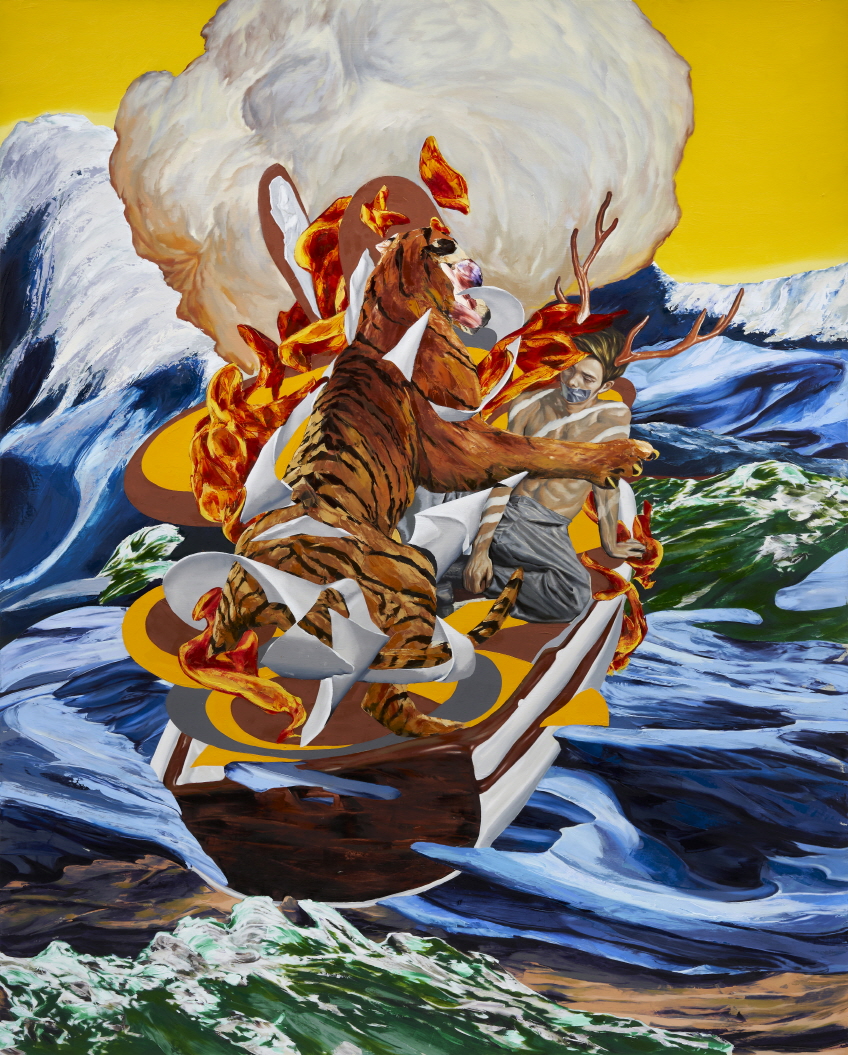
Indeed, the Park’s Park series appears to possess a large-scale narrative structure. Its dramatic compositions, reminiscent of historical paintings, together with titles that seem deceptively simple yet refuse easy clarity, thoroughly unsettle the viewer. We often say that in art one sees as much as one knows—but precisely because of what we know, we end up seeing only what we already know, trapping ourselves in that paradox.
In this sense, the artist’s intention—to “mock the conditions of the art world by exploiting the contradiction of interpreting objects only through learned and internalized frameworks, and to break free from the roles society assigns to artists”—finds a precise and elegant realization. And yet, despite all this, creating and reading one’s own narrative within these works remains unmistakably the viewer’s task. That, too, is one of the distinctive pleasures of engaging with contemporary art.
Now, after a long interval, Park Jung Hyuk presents a new body of work, Park’s Memory. These new works, revealed after years of silence, are at once reminiscent of his previous practice and strangely unfamiliar.
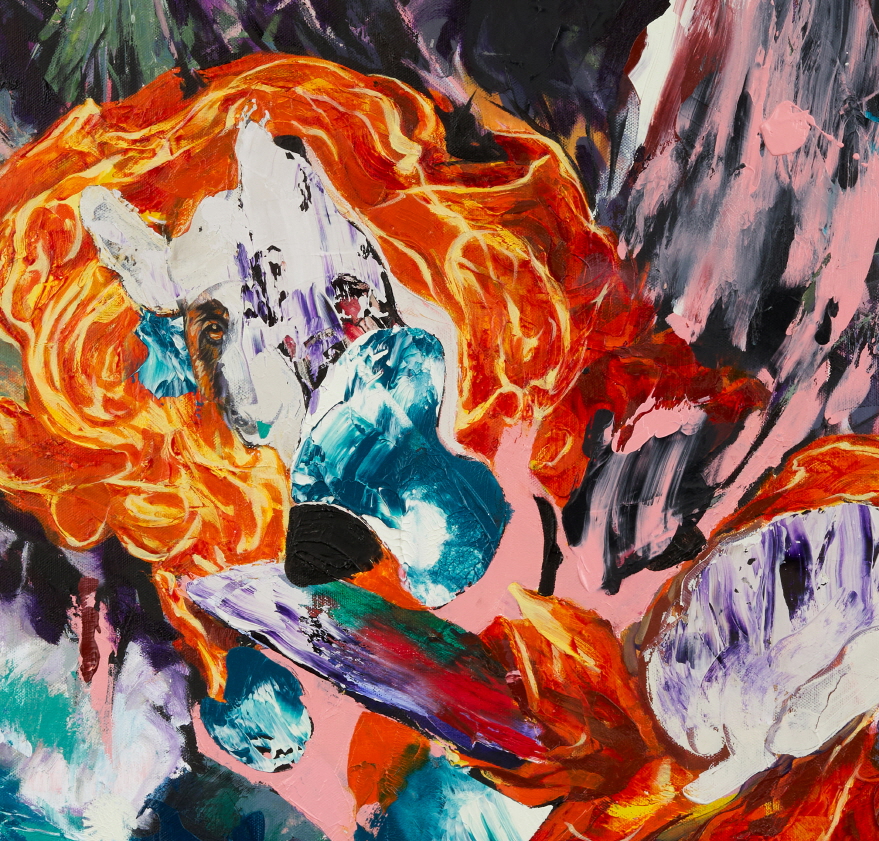
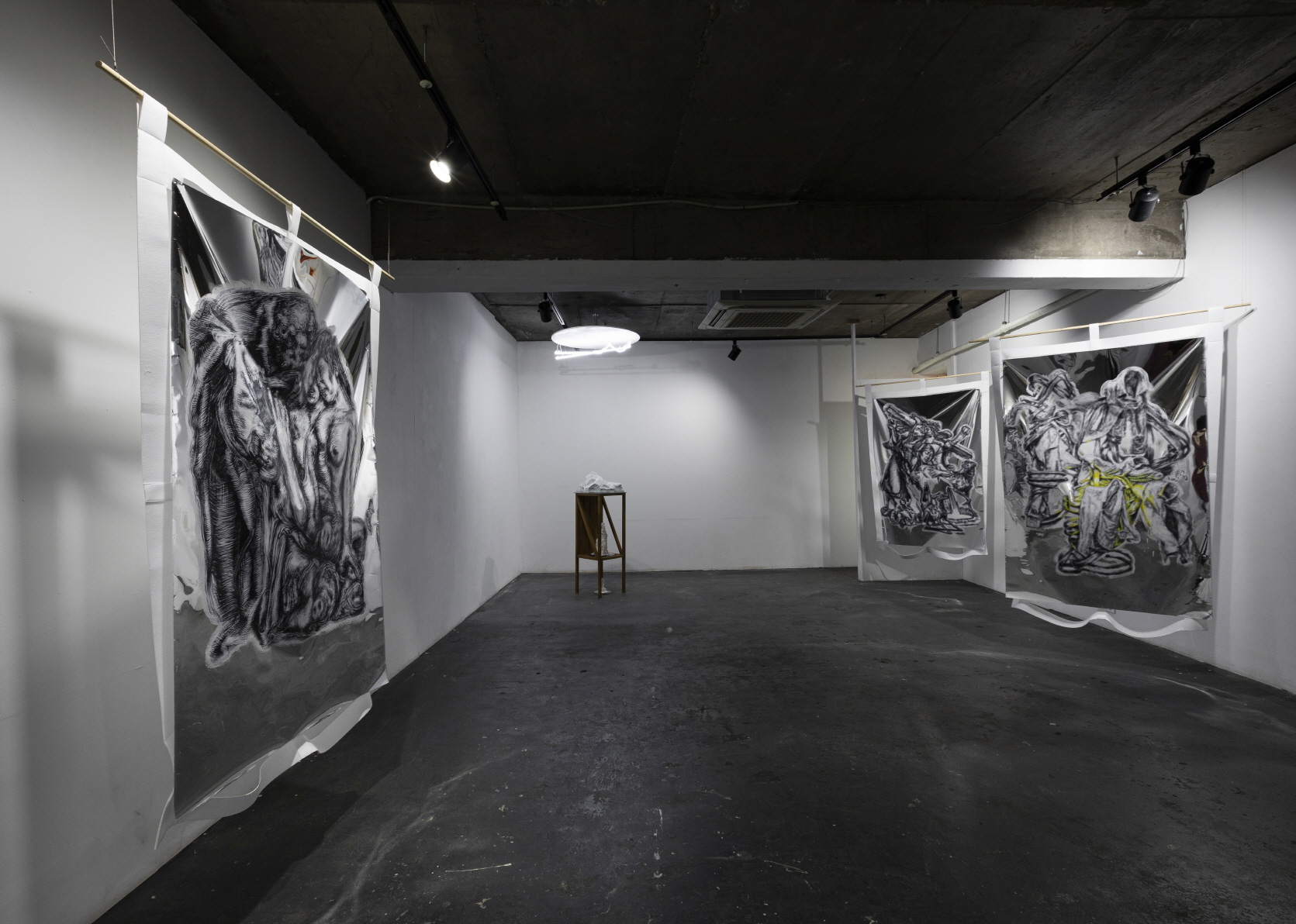
They are unfamiliar not only in relation to his earlier works, but also when compared to conventional painting itself. Instead of ordinary canvas, he uses thin silver foil—a surface that reflects one’s face and shimmers with even the slightest movement. Seeking to escape the banality and inertia of canvas, the artist happened upon a silver foil slightly thinner than that used for snack or ramen packaging and decided to paint on it.

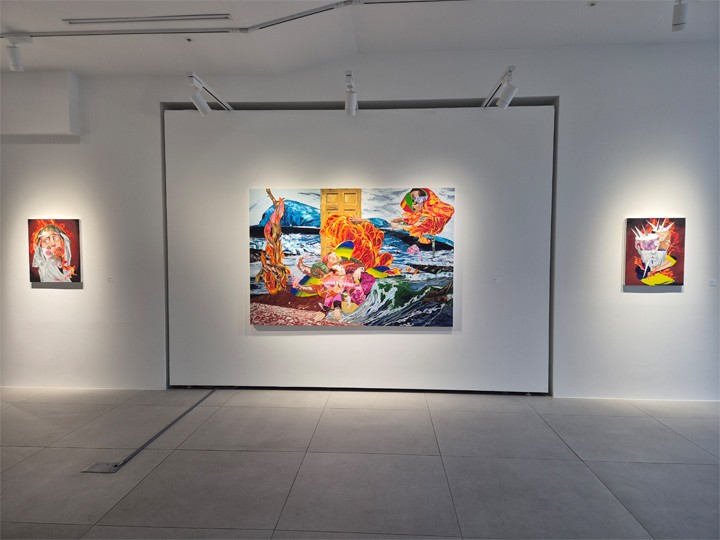
Installation view of《Park’s Memory - The Temperature of the Senses》©Dorothy Salon
Although this is not Park’s first time working on reflective surfaces—mirrors have long been used in painting and sculpture alike—the difference lies in distortion. Mirrors, being solid and stable, offer relatively reliable reflection. The silver foil Park has chosen, by contrast, is not solid; it cannot reflect forms faithfully.
Unless it is perfectly adhered to a flat surface, its thinness inevitably produces wrinkles and distortions under the influence of air. Moreover, its density and translucency differ from those of a mirror, preventing any clear and stable reflection. This is precisely why silver foil is not used as a mirror—and precisely why it resonates so powerfully with the theme of Park’s Memory.
As the title already suggests, this work is about memory. After years of critically engaging with social contradictions and structural problems, why and how has the artist returned with memory as his subject? And what kind of memory does he present?
Many artists work with memory. Memory can be private or public, linguistic or visual, visual or auditory, olfactory, gustatory, or tactile. We remember through all five senses. Yet memory has both a fatal flaw and a crucial virtue: its incompleteness.
Park Jung Hyuk focuses precisely on this incompleteness. Memory is always selective, whether consciously or unconsciously, and it is continually distorted over time. The very moment we try to remember, distortion begins.
As we retrace the past, memory is layered upon memory, and what emerges is no longer the past as it was, but a version modified—sometimes slightly, sometimes profoundly—by the present.

Installation view of《Park’s Memory - The Temperature of the Senses》©Dorothy Salon
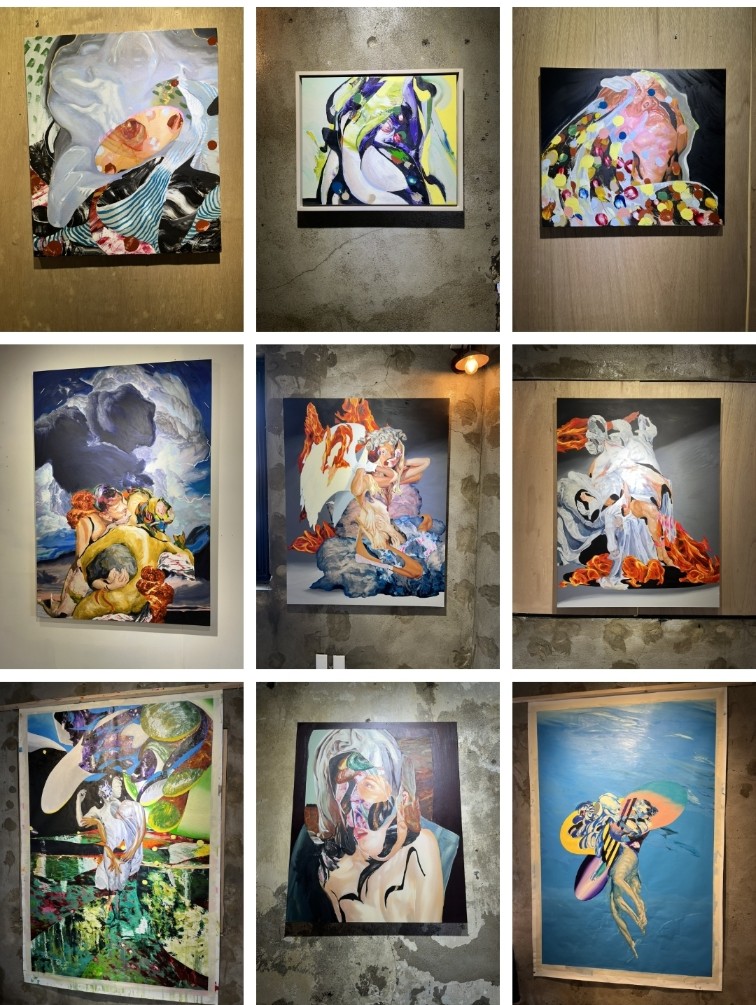
‘Park’s Memory’ visualizes this process of adding and erasing, through which memories become incomplete, unclear, and ambiguous. We remember because something was once registered in our minds through our senses—whether we saw it, heard it, smelled it, tasted it, touched it, or experienced all five at once.
Those initial impressions, recorded “as they were,” resemble the clear underdrawings the artist paints onto the silver foil. They appear sharp at first, yet because the surface itself is unstable, distortion begins immediately. Over time, new images are added and others erased, and the image alternates between clarity and blur, eventually forming a vast constellation of layered memories. These accumulated layers produce new images that feel at once strange and oddly familiar, hovering in a state of uncertain recognition.
As its title implies, 'Park’s Memory' originates in the artist’s own private recollections. Yet many of the images seem strangely recognizable to us. Despite the countless distortions his memories have undergone—and despite their deeply personal nature—we find ourselves able to look into them.
Perhaps this is because they are rooted in experiences shared by those who have lived through the same era and society. Park’s family and close acquaintances may discover even more specific memories in these works, but even without any personal connection to the artist, viewers may still find their own memories reflected there—much as we discover fragments of our own lives while reading a fictional novel.
The distance between private and public memory, between personal and collective experience, may not be as great as we imagine. Thus, within the shimmering, translucent layers of silver foil, we once again find ourselves constructing and reading our own narratives—whether the artist intended this or not.
In this solo exhibition,《Park’s Memory - The Temperature of the Senses》, presented seven years after his previous one, Park Jung Hyuk speaks for the first time solely through painting, without video or installation. The social contradictions and conflicts that once appeared so explicitly in his work are now far more subdued—indeed, carefully hidden.
How should we respond to this shift? The answer is simple: by trusting the temperature of our own senses. Let us feel and read according to our own sensibilities—shaped, no doubt, by social learning and discipline. Or perhaps we need not even read. Simply sensing, empathizing with, and remembering these images may already be enough.

Installation view of《Park’s Memory - The Temperature of the Senses》©Dorothy Salon
In this solo exhibition,《Park’s Memory - The Temperature of the Senses》, presented seven years after his previous one, Park Jung Hyuk speaks for the first time solely through painting, without video or installation. The social contradictions and conflicts that once appeared so explicitly in his work are now far more subdued—indeed, carefully hidden.
How should we respond to this shift? The answer is simple: by trusting the temperature of our own senses. Let us feel and read according to our own sensibilities—shaped, no doubt, by social learning and discipline. Or perhaps we need not even read. Simply sensing, empathizing with, and remembering these images may already be enough.
In the scorching summer of 2018, as a once-in-a-century heatwave exhausts us all, Dorothy Salon warmly invites you to enter the layered fields of memory that Park Jung Hyuk has constructed in《Park’s Memory - The Temperature of the Senses》, and to take time to rediscover the fleeting traces of your own memories and sensations within them.
Writings