Criticisms
Malocclusion
2004
Kim Ki-yong
The Loss of a Blurred Object
● 1. Against a white wall, a domestic camcorder is mounted on a tripod. Through the camcorder’s small screen, we see a person training dogs. The video lightly condenses a training process that unfolded over several months.
Just as there is hardly anyone who has not kept a puppy at least once during childhood, most people carry some experience of raising a dog. In the course of living with a dog—when it fails to distinguish where to relieve itself, or through various other incidents—one inevitably arrives at the decision that some form of training is necessary. Within that process, countless subtle emotions become entangled, and because dogs have a shorter lifespan than humans, they also teach their owners about death and sorrow.
In any case, the image captured on the camcorder screen feels somewhat odd, familiar, and even comic. It is nothing more than a fleeting, lightweight image produced by an easily handled household device. It merely makes a gentle, tickling gesture toward our eyes, evoking a pleasant memory from another time.
● The camcorder’s gaze, momentarily fixed on a blurred wall devoid of any concrete object, steps away—if only briefly—from the politics of relationships or from aesthetic meaning that surround me. Instead, it reveals a leisurely daytime pastime of training dogs, or more precisely, of playing with them. Even without a specific object, the artist allows a strand of memory, reactivated in the present, to slip and flicker into view.

training, 2003, Single-channel video, 6min 13sec

training, 2003, Single-channel video, 6min 13sec
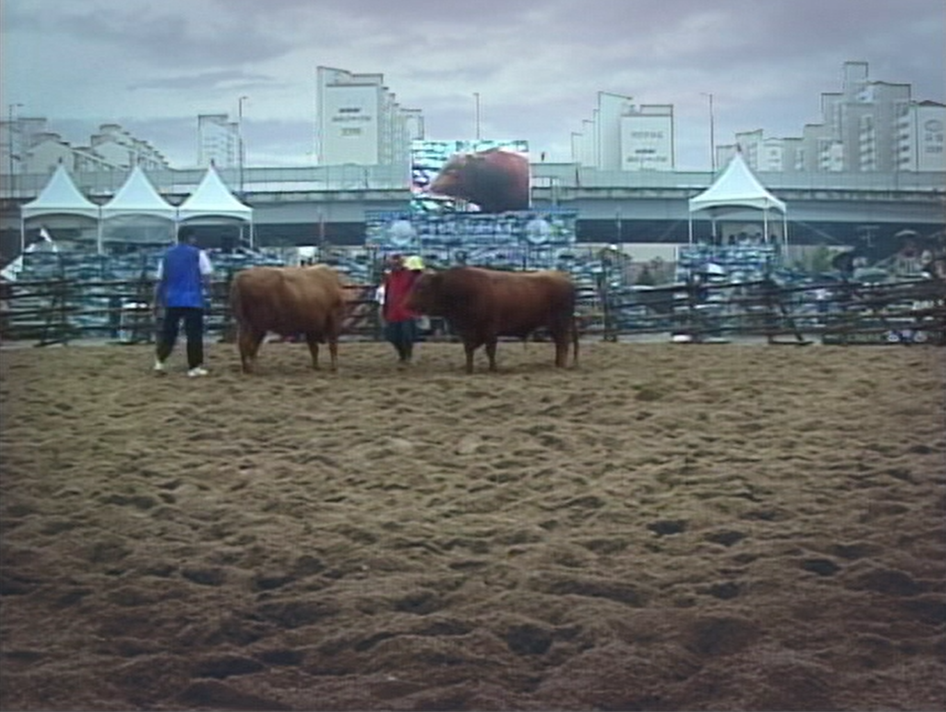
festival, 2003, Single-channel video, 4min 8sec
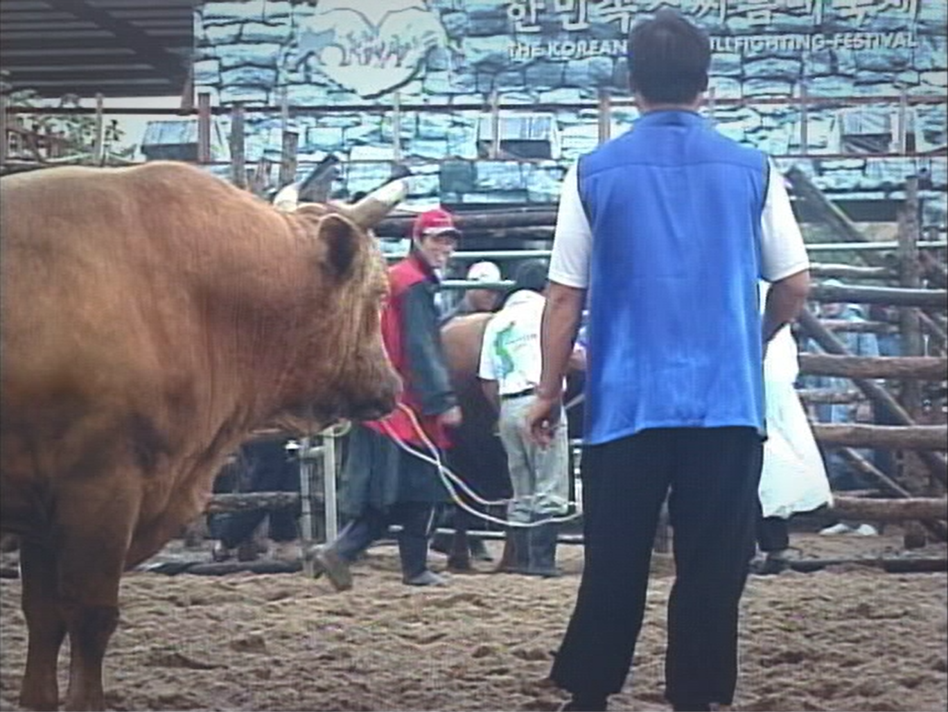
festival, 2003, Single-channel video, 4min 8sec
2. The grandmother’s shallow breathing, accompanied by intermittent groans that pierce the ear with discomfort. It is difficult to speak of Park Jung Hyuk’s video and sound works through a “white,” neutral gaze that would reduce them to mere biological respiratory phenomena. Rather, they gesture toward the artist’s upbringing within a Korean middle-class household, and toward the layered emotions and accumulated thickness formed within such an environment—not in the register of melodramatic sentimentality, but through sticky familial affection and irrational emotional bonds. The video quietly exposes these backgrounds.
What appears to be mechanically sustained breathing—life prolonged through technological apparatuses—is rendered visible through sensor-driven movements of mechanical ascent and descent, which animate the grandmother’s image and sound.
● Why a grandmother? Why the exhausting image and uncomfortable sound of an ailing grandmother? How are we to read Park Jung Hyuk’s psychological inquiry, which presents a Korean form of persistent, irrational attachment rarely encountered in other video installation works, staging both an individual’s tragic drama and its anticipated final act?
I find it uncomfortable to describe Park Jung Hyuk’s video works merely as an archive of memory that recalls his own lived experiences and events, or as representations of another individual distinct from myself. This is because the figure of the “grandmother,” a common noun of shared memory to which all viewers can relate, cannot be adequately contained within a few lines or paragraphs.
As an archetype of sorrow and simultaneously as the womb of life itself, as a symbol of primordial love, the grandmother generates countless emotional aftershocks. Perhaps what ultimately distinguishes Park Jung Hyuk’s video installations from those of others lies precisely in this unconscious substratum.

166cm, 2003, Sound interactive video installation, Mixed media, Dimensions variable

166cm, 2003, Sound interactive video installation, Mixed media, Dimensions variable
3. Video installation works by younger artists emerging in the late 1990s display a distinctly intellectualized tendency. Park Jung Hyuk’s work also bears traces of this inclination. However, in this solo exhibition, he departs from such a cognitive orientation and instead maintains a slightly askew stance, presenting a unified emotional register or atmosphere.
By juxtaposing the light, almost playful video of dog training with the starkly different, narrative and monument-like atmosphere of the grandmother video installation, he stages a contrast of emotions. Through this contrast, he recalls the entanglement and release of multiple emotions within a single individual—association and oblivion—and appears to commemorate, through mechanical or affective imagery, those things that once existed but have since been lost: objects that remain fundamentally ambiguous. ■ Kim Ki-yong
Writings