Criticisms
IMAGENATION – On the evolution of arts.
2009
Lee Daehyung | CEO, Hzone

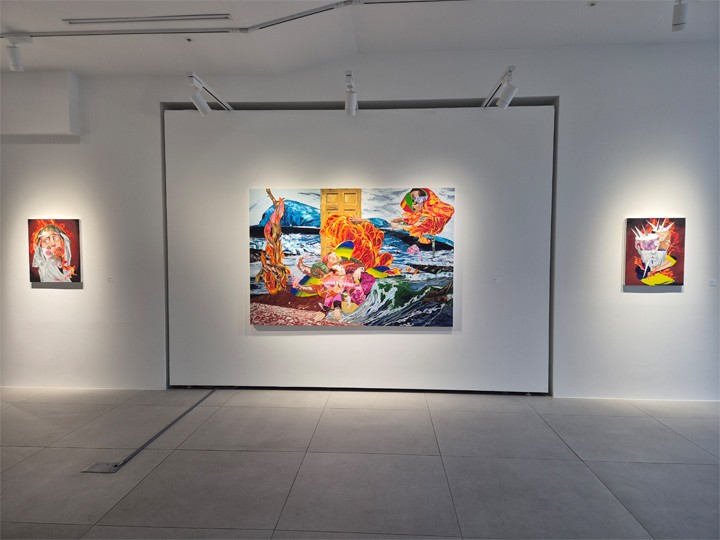
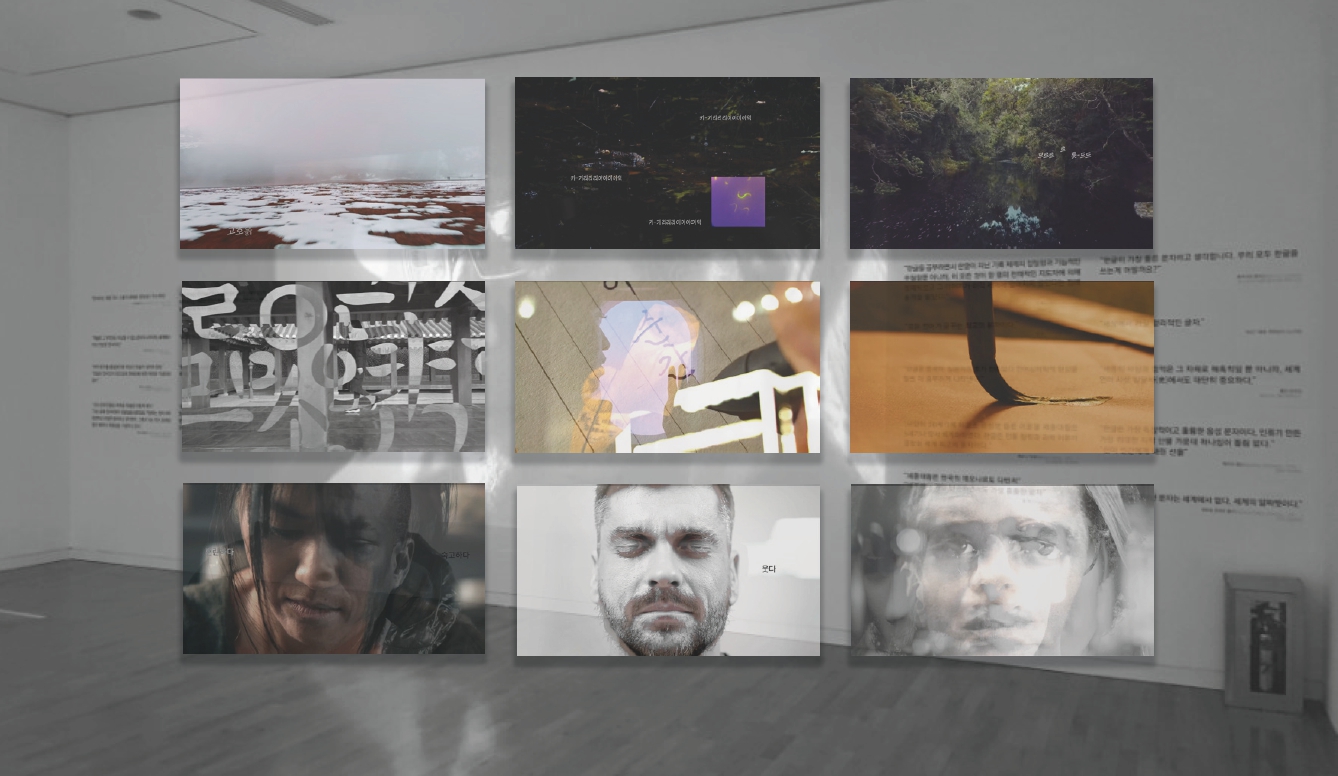
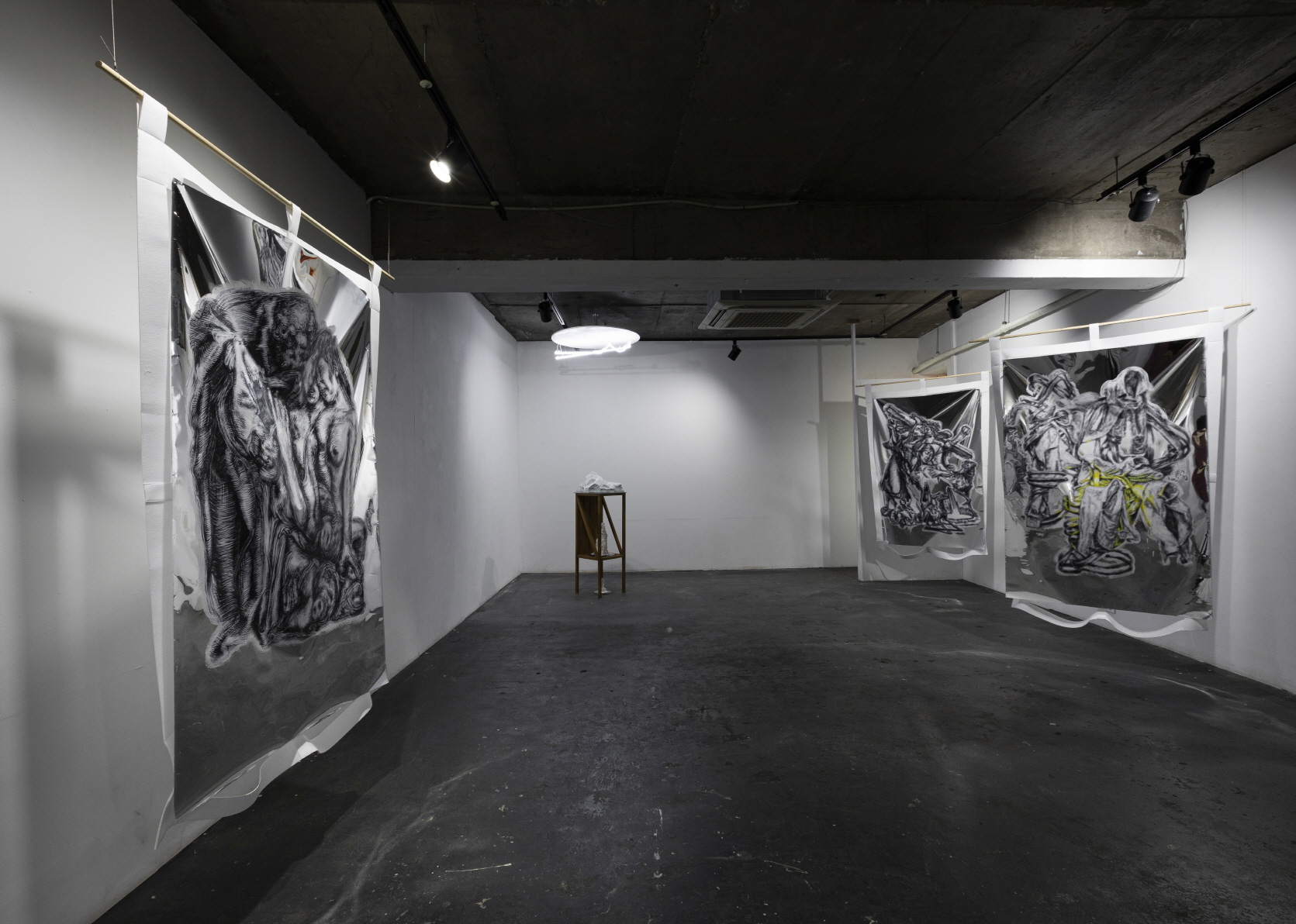
Installation view of《IMAGENATION》©Salon de H
From the incantation as a substitute to language, symbol of divine right and royal authority, maid of architecture, the Renaissance Man Leonardo Da Vinci, independence from illusionism, the birth of photography, Andy Warhol’s factory, Nam Jun Park’s video art, Jeff Koons’ scandalism to Damien Hirst’s return to painting, art has never stopped evolving. It refuses the boundaries set by culture, politics, economy and religion in search of its own identity. Revolt, coup d’etat and subversion didn’t leave it hesitant. At the center of the history of revolt stood image.
The evolution of art continues to this very moment, waving the flag of “image.” With the shift of the central axis of art from a holy temple of the God to a field of humans, a monopoly by the ruling class to mass consumption, society-led to individual-driven, image gathered greater strength. Long-standing walls crumbled, giving way to a new horizon. As image aggressively expanded its territory, the walls that separated sculpture, painting, photography, image, installation and conceptual arts for hundreds of years came down one after another. The multi-media environment created by the internet propelled the distribution of image at a speed faster than text, and the response to communication also expanded and reproduced immediately and continuously. As image became more individualistic, refusing to belong to a certain genre, the independence movement of the former parasite has started to gain momentum.
This is a change that signifies the consilience of diverse genres, rather than the overthrow of individual genres. Image, which has enabled this very evolution of art, has grown substantially that it can no longer be confined to one boundary. It is quick, breeds aggressively, whimsical and has devouring appetite. A new shape of image liberated from the shackles of formality. Does this leave you wondering how the evolution of art will unfold?《IMAGENATION》is an exhibition that stages the works of Lee Yongbaek, Park Junghyuk and Cho Hoon, the masters of this “whimsical matter”.
Image that now transcends photography, painting, sculpture and image boldly reveals itself to the world. Taking on new formats, image unmasks the paradox and limitations hidden in this modern society and the desire and disguise of human beings. Sometimes relying on eye tricks and bait and occasionally repeating exposure and hiding, image attacks the absurd dichotomy of real vs. virtual, individual vs. society and secular vs. holiness.
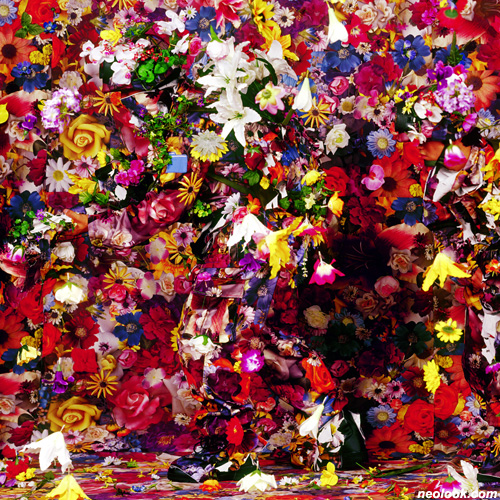
Lee Yongbaek, Angel Soldiers, 2006, C-print, 130 x 130 cm ©Artist
First, the artificial plastic fish in the work of Lee Yongbaek captures the eyes of the audience. The fake bait mass produced to catch real fish catches the eyes of the audience. Plastic fish is larger and tastier than real fish. The audience, blinded by the scales of splendid color, becomes forgetful of the fact that sharp needle is hiding underneath. The group hypnosis that makes people lose their mind and miss reality is repeated in Plastic Eye, a painting of a massive artificial eye. The real eyes of the audience staring at the big fake eye marks the struggle of power between the real and simulacra.
A miniscule movement is detected in a space decorated with flowers. Immediately, the chirping of the bird stops. It detected approaching danger. The birds resume singing not long after the soldiers, camouflaged as flowers like chameleon, stop moving. Angel Soldiers are not only after hiding birds. The audience, struggling to figure out whom to range with – bird chirping vs. footprint, nature vs. human being, game vs. solider, flower vs. weapon, peace vs. violence - also becomes the target of hunting.
Plastic Pieta, inspired by the sculpture of the Virgin Mary saddened with Jesus in her arms, appears unfamiliar. The fact that the two characters - who remind of cyborg - are actually one does not become obvious unless you take a close look. The Virgin Mary is the mould and Jesus is the person that came out of the mould. One is the seed and the other is the skin that gave birth to the seed. The concept of two originating from one render the distinction between mother vs. son, God vs. human, life vs. death and original vs. copy meaningless.

Park Junghyuk, Park's park 7, Acrylic on canvas, 140 x 250 cm ©Artist
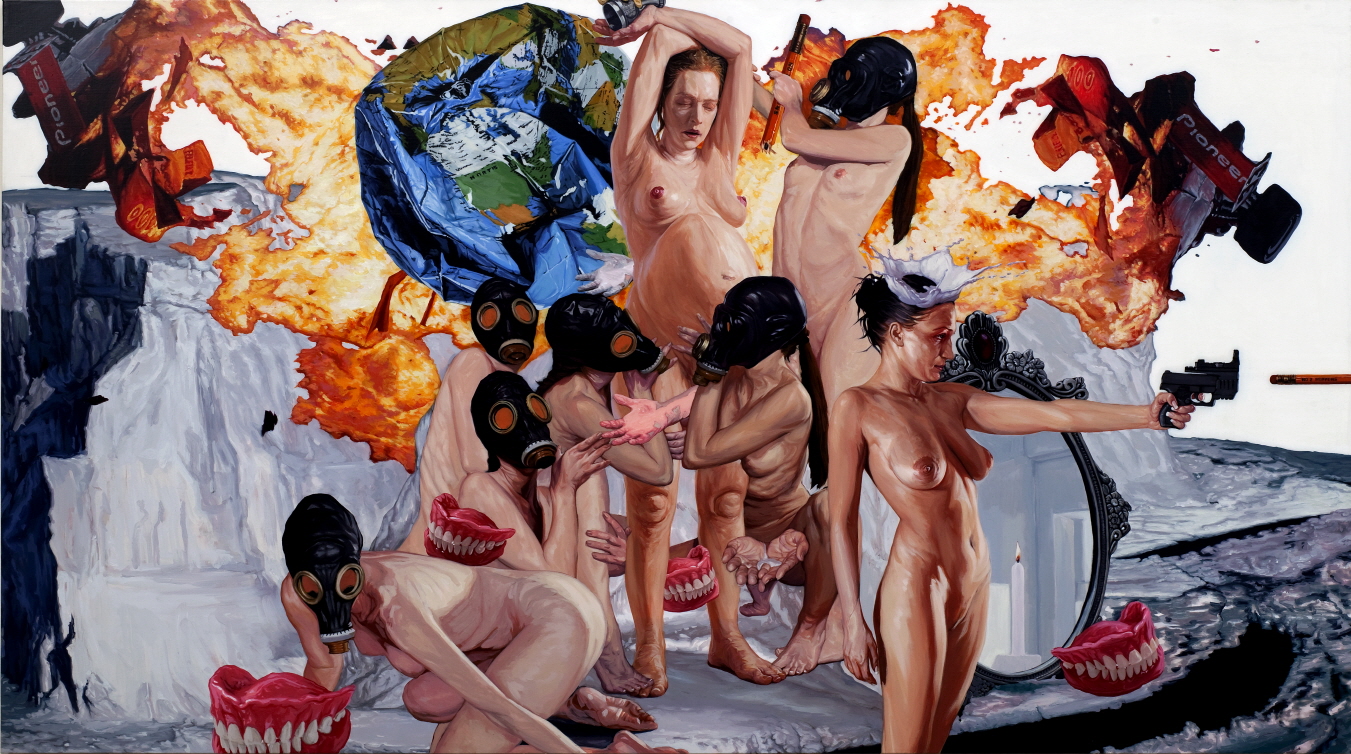
Park Junghyuk, Park's park 8, Acrylic on canvas, 140 x 250 cm ©Artist

Park Junghyuk, Theater Series-3’ 54”, 2009, HD video, 3min 41sec ©Artist
Communication gives a new context to image and thus a new meaning. Park Junghyuk, who started as a media artist, clipped images with roots in diverse context spanning news, ad, porn sites and movies to complete a landscape, ‘Park’s Park’. Skilled in media movie directing, he understands well the nature of media where stories have to be processed and interpretation controlled. To complete a work, the private intentions and personalities of the individuals are reinterpreted in light of the big picture, and the vivid expressions of the collaged images cover up the seams. With seamless editing, the touch points of various contexts vanish. The start of flawless camouflage, or a liberal separation of signifier and signified.
Cross-cutting and time splitting. These are technical terms used in video editing that we first need to learn in order to understand Theater Series: 3 Minutes 41 seconds, the video work of Park Junghyuk. Repetition of concealing and exposure is used to translate the image that came across his mind into a story. The character in the screen doing boxing leaves the audience wondering if his actions are for real or not. Is he fighting by himself or is he fighting with someone? Once the audience becomes aware of the technical terms of cross-cutting and time splitting, the audience is bound to be fooled with disguise and acting.
The photo work Edge series – Actor Park Kwangil. The actor is handed the drug box that the artist carries. As soon as the box lands on his hands, he acts of painfulness and agony. Not because somebody told him to do so. It’s a natural result from a combination of social norm that says that drug box is an instrument that alleviates pain and the actor’s obsession that he has to act according to such common knowledge. An example of the typical behavioral pattern of human beings who act as they were educated is illustrated through this dramatic photo work.

Cho Hoon, Rewind, 2007, Mechanical devices, Variable installation, ©Artist

조훈, Ecstasy, Synthetic resin, 210 × 130 × 7 cm ©Artist
The posture of the massage girl in the leaflet thrown away on the street is so diverse that it is practically worth collecting. It is as extensive as men’s desire for secretive voyeurism. In an attempt to rescue the distorted image of women crafted by the consumption society addicted to sexuality, artist Cho Hoon magnifies the image of women and opts for relief, a midway between three-dimension and two-dimension, to completely deny contact of men.
It is a result of the unquenchable human desire. Ecstasy uses pure white for a feel of divinity. The secular pose overlaps with the aura of a Goddess. While human beings are busy praying for social desires, the image of women in Cho Hoon’s work represents the secret desires of human beings. The difference between holy vs. secular, God vs. human and wish vs. desire is as thin and as volatile as a relief.
Video workRewind. In each section of a toilet paper roll is a drawing of a lustful women drawn using black Chinese ink. As the paper unrolls, the lewd drawings reveal their shameful scenes through closed circuit and projector. The image of women carefully drawn on the toilet paper to fulfill men’s desire further stimulates voyeurism and magnifies. The anxious obsession that somebody may be watching is fully revealed on the wall along with the toilet paper that rolls carefully.
A new painting by Cho Hoon that disappears when viewed from the sides and only displays itself, albeit vaguely, when viewed from the front. The audience, liberated from secretive watching, now becomes immersed in the desire to complete the unstable form. The work completes itself by taking a picture of a semi-nude body of a woman in relief, transfers it onto the canvas and leaves a halftone dot on it. The countless halftones, however, are not cover ups of the exposed women’s body.
“All images are mere halftones.” as Roy Lichtenstein had said, halftones are a vehicle that illustrates that a sexy image as interpreted with the audience’s perception is just a collection of small halftone dots.
The old gates of painting, sculpture, video, installation and photographs are at a distance. However, the hinge is bound to fall off when the door becomes too old. Nobody can guess how the unhinged door will fling open. That is how art looks like today. It no longer moves in the anticipated direction and speed. New approaches and imagination are needed to open the door to a new world.
《IMAGENATION》demands a new and creative interpretation of the world and refuses to be bound by superficial formality. The evolution of art changes its course depending on how the images are viewed from what angle and attitude. Those with the imagination and creativity to conquer the world with the “IMAGE” flag flying high will be the heroes of IMAGENATION.
Writings